

ScalePad is a Business Reporter client
Another day, another cyber-attack making headlines. While big corporations often steal the spotlight, the reality is that small businesses are at higher risk and targeted more frequently than their larger counterparts.
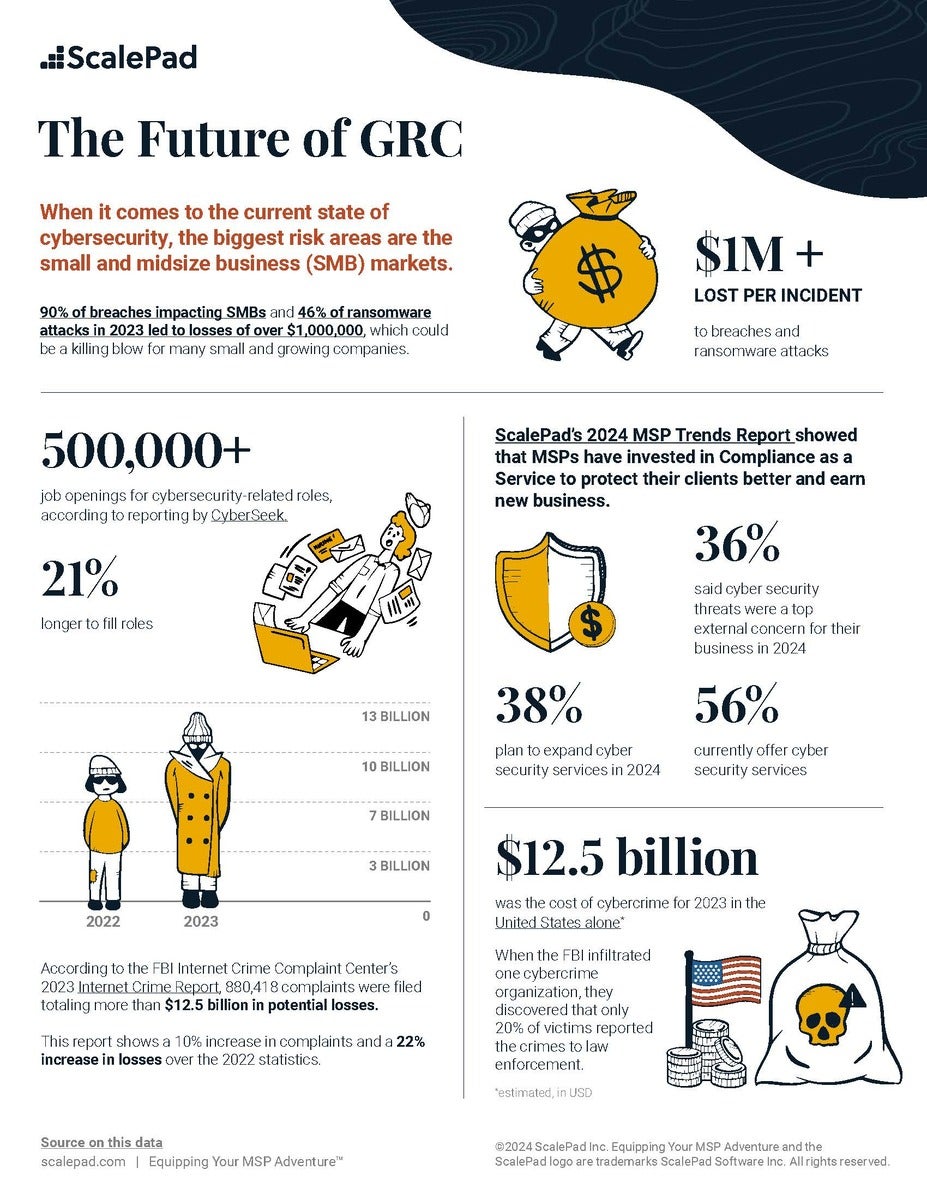
The current state of cybersecurity shows that small and midsize businesses (SMBs) are the most vulnerable. More than 90 per cent of breaches impact SMBs, with 46 per cent of ransomware attacks in 2023 resulting in losses between $1 million and $10 million, a significant blow for small companies.
Despite the common belief that only big companies are targeted, many SMBs have a dangerous “it’ll never happen to me” mindset. Unfortunately, this way of thinking can be a trap.
Small business cyber-threats often go unnoticed in the news, but statistics show that 61 per cent of SMBs were targeted by cyber-attacks in 2021. A UK study revealed that 60 per cent of small businesses would close within six months of a cyber-attack.
In response to the growing threat to SMBs, governing bodies and industry regulators worldwide are implementing stronger cyber-crime protection standards. This has led to the need for SMBs to incorporate governance, risk management, and compliance (GRC) into their business practices.
Cyber-security for SMBs
While large enterprises have long used strong GRC structures for security and operations, smaller organizations are now recognizing the importance of GRC in meeting cybersecurity requirements globally.
These industry frameworks go beyond best practices to provide concrete steps for cyber-crime protection, reducing the risk of breaches and data loss while implementing standards for incident recovery.
Although smaller organizations have been slow to adopt GRC, the trend is changing. Whether it’s a small company servicing a regulated business or a school with limited IT resources, the need for security compliance is becoming essential.
With compliance regulations trickling down, SMBs must embrace GRC to meet new security standards when working with industries like healthcare and finance.
Small businesses need to adopt GRC
While cyber-attacks on big corporations grab headlines, cybercriminals are increasingly targeting smaller vendors in supply chains. Organizations like Boeing and over 200,000 others working with the US Department of Defense (DoD) are now required to comply with the Cybersecurity Maturity Model Certification (CMMC).
Expanding and updating CMMC benefits SMBs and subcontractors working with the DoD, emphasizing the importance of GRC adoption. Compliance with security frameworks enables organizations to implement backup and recovery policies, information security controls, and incident response protocols to enhance security posture and reduce risk.
How do SMBs tackle compliance and governance?
In the high-demand mid-market for cyber-security and IT services, businesses are struggling to find qualified personnel due to resource constraints. As a result, many organizations are turning to their existing IT support or managed service providers (MSPs) to help establish GRC.
At ScalePad, we’ve witnessed this trend firsthand. MSPs are increasingly offering compliance as a service to protect their clients and meet new security requirements. This shift towards cybersecurity services reflects the growing importance of security in the industry.
Governments are also stepping in to support small businesses in enhancing their security measures. Initiatives like the FCC’s $200 million pilot program for schools demonstrate a commitment to improving cybersecurity for vulnerable organizations.
GRC is the future of security for small businesses
The push for cyber-security in SMBs is just beginning, with more regulations on the horizon. Businesses that prioritize compliance as a service and GRC tools will be better equipped to meet evolving security standards.
As we look ahead, ScalePad is committed to serving IT professionals through our security and compliance platform, ControlMap. From large corporations to small businesses, proactive security measures are now a top priority for all.
You can download The Future of GRC Infographic here.
By Dan Fox, Cybersecurity Lead, ScalePad and Evan Pappas, Content Writer, ScalePad